One flower.
The whole paddy survives.
A Balinese cooperative converts a corner of the paddy to blue lotus, changes the arithmetic on the land, and keeps the rice fields — and the families who tend them — from being sold to developers.
Status: early stage · 2 partner farmers near Ubud · Blue Lion prototype in development · Water systems planned
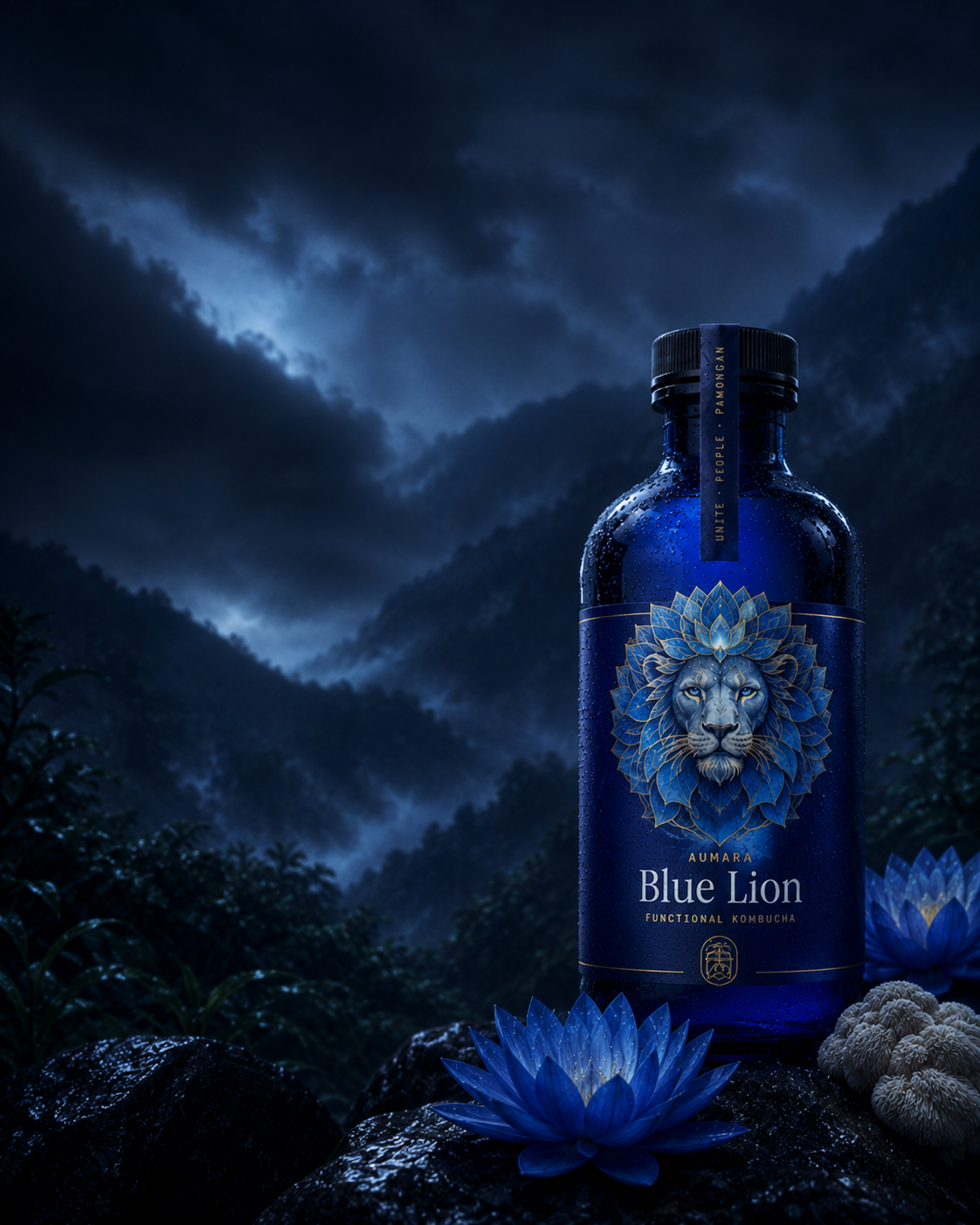
Nymphaea caerulea. The blue lotus.
Nymphaea caerulea has been cultivated in warm, shallow freshwater for at least three thousand years. Ancient Egypt drew it on temple walls and floated it in the pools of the pharaohs. In Bali it blooms in the same irrigation channels the Subak has maintained for a thousand years.
The blue lotus is a water lily native to Egypt and East Africa, naturalized across tropical Asia. It opens as the sun rises and closes at dusk. The petals are a pale blue-lavender — the color of shallow water in cloud-filtered morning light.
The plant grows in still, warm, shallow water: exactly the conditions the Subak creates in highland Bali. It does not compete with rice. It thrives in the same channels, the same temperature, the same season.
The flowers contain two alkaloids — nuciferine and aporphine — that produce a mild, clean quietening. Not a sedative. Not a psychedelic. A loosening of the edge of the day. The Egyptians called it the opening of the eye.
Ancient records describe steeping the petals in wine for ceremony. Balinese families float the flowers in temple offerings. Herbalists today brew it for sleep support and mild anxiety relief. We brew it into Blue Lion.
The fullest blooms open before dawn, in the cool hours before the sun touches the water. The petal harvest is lunar — aligned to the Balinese calendar, not our production schedule. The ceremony belongs to the farmers. We receive what they grow with gratitude and turn it into something worth brewing.
The paddies are leaving. One family at a time.
A Balinese rice farmer earns about Rp 40 million per hectare per year. Then a developer offers fifteen billion. The math is impossible. The paddies disappear. They have been disappearing for thirty years.
The Subak — Bali's thousand-year-old cooperative water management system, a UNESCO World Heritage practice — depends on contiguous wet rice cultivation. When one family sells, the irrigation logic for the entire village downstream begins to fail.
With the paddies go forty generations of agricultural practice, the heritage rice varieties those families carry, and a community ethic that organized this island into terraces instead of plantations.
It is not that the farmers want to sell. It is that the rice economy cannot compete with construction. The mathematics forces the answer.
Every conservation effort, every government program, every NGO campaign — they all run into the same wall: rice doesn't pay, and the developers do. Pricing is the lever. Until something changes the per-hectare yield from the land, the paddies will keep going.
Ten percent of the field
changes the arithmetic.
Convert ten percent of the land to blue lotus ponds. Earn Rp 30–50 million per month from that ten percent. Keep the other ninety percent in heritage rice. The Subak survives because the lotus on a corner of the field made the rest solvent.
-
01The lotus grows in the same water as the rice.Blue lotus shares irrigation logic with paddy rice. The ponds can integrate into existing Subak channels without rerouting water rights or breaking the cooperative system.
-
02No displacement. No monoculture.Ninety percent of the field stays in heritage rice. The family keeps farming the way they have for generations. The lotus is a corner of the operation, not a replacement.
-
03The flower has a buyer.Cooperative brewing and bottling on Mount Batukaru gives every pond an off-take partner that is also a member. The price doesn't flex against the farmer. The price is the structure.
The same family. The same land. The same Subak. A thirteen-times jump in income from a corner of the field. The choice between keeping the farm and selling to a developer stops being a choice.
The farmers own this.
Aumara is a customer of the cooperative. We are not a manager of a supply chain. The farmers retain title to their land. The cooperative holds the brewing infrastructure as a shared asset. Every bottle that ships routes a token royalty back to the family whose lotus is inside it.
Member-owned. Farmer households are shareholders in the cooperative-token vehicle. Decisions about price, harvest cadence, and brewing scale are made by the cooperative, not by an outside investor.
On-chain royalties. Each bottle carries a QR code that scans to the farm, the harvest, and the cooperative wallet. Token royalties route automatically on each scan-verified sale. The supply chain is transparent because it is on-chain.
It isn't a fair-trade label slapped on a corporate operation. It isn't a tourist brand performing tradition. It isn't outside money buying its way into ownership of Balinese heritage farming.
It is a cooperative. If the cooperative ends, the brand ends. The economics close only because every party in the loop is also a member of it.
We did not invent any of this. The mountain made the water. The farmers grew the lotus. The Subak built the water ethic. Tri Hita Karana built the moral framework. Our only job is to organize them honestly.
The water is
the product.
We source from Bali Rain for the current prototype — filtered Balinese rainwater, collected and processed on the island. It works. But there is a better version of this story, and we are building toward it.
Mount Batukaru's cloud-saturated forest at 2,276 meters is the source. Angled aluminum V-louver panels face the open night sky and cool below the dew point through radiative emission — humid mountain air condenses into droplets that roll into gutters and flow into storage. No aquifer. No spring. No Subak channel touched.
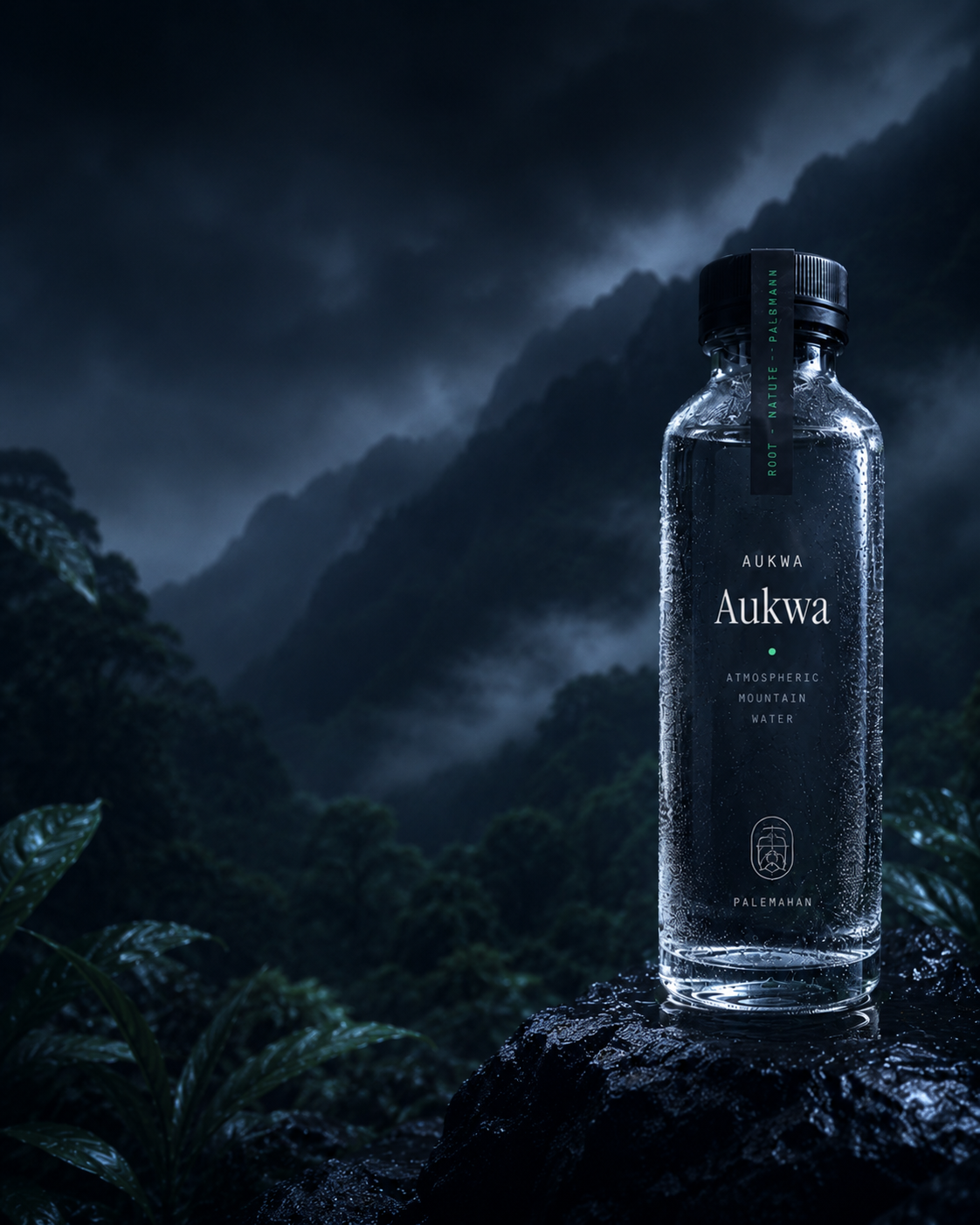
The water feeds a five-stage filtration and volcanic mineral remineralization chain. It bottles as drinking water under the name AUKWA — from the AUMA roots au (breath, spirit) and akwa (water). Breath-water.
The system runs in two modes: dew collection on humid nights, and rainwater capture during wet season. As Bali's lowland water supply comes under increasing pressure, a highland source at altitude only gets more valuable, not less.
The plan is to power the array entirely off-grid with solar and battery storage. No grid dependency. No fuel. The same sun that grows the lotus draws the water from the cloud above it.
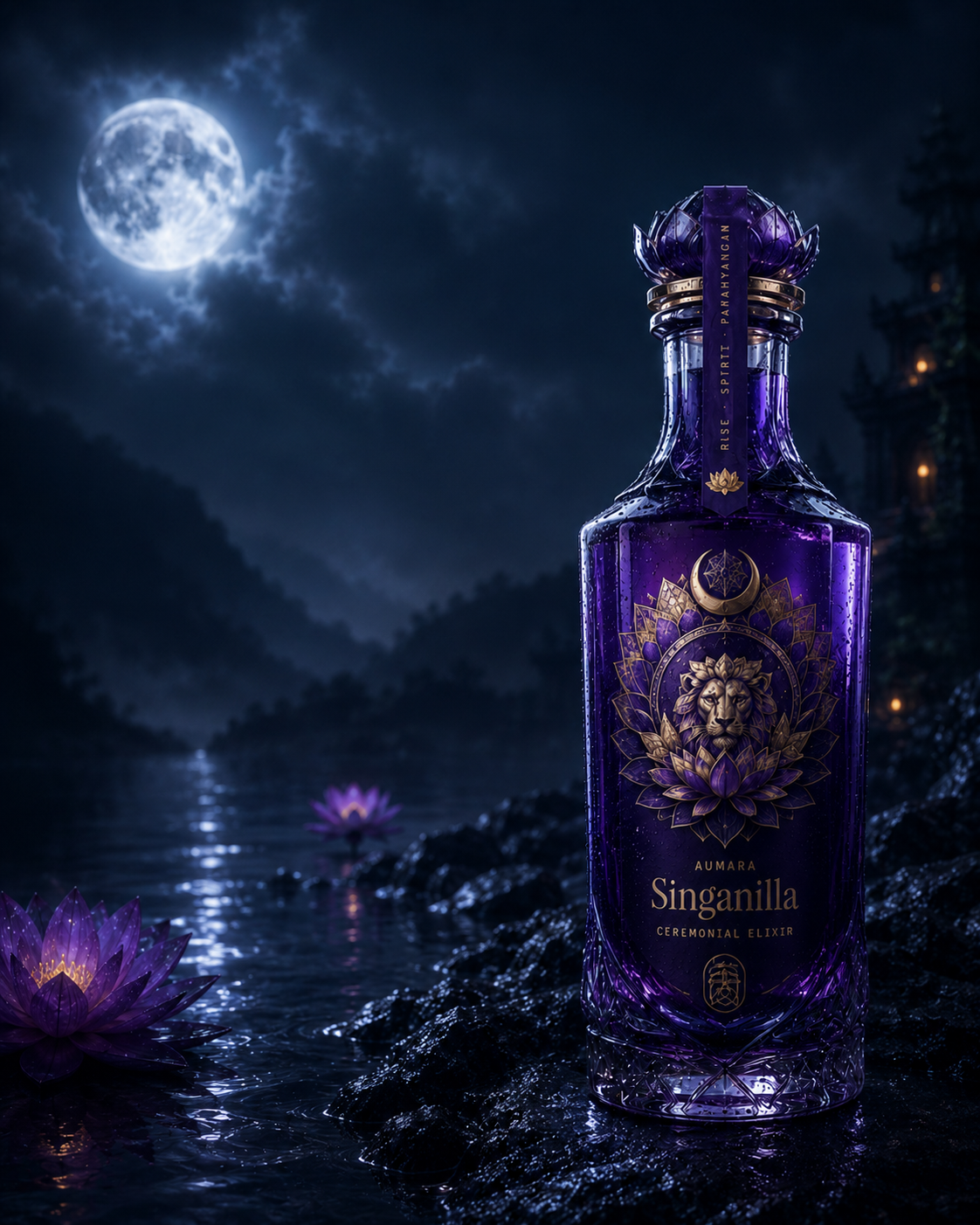
Three products. Proof the cooperative produces.
The mountain gives the water. The farmers grow the lotus. These are what comes back. Three loops on the trefoil mark — one for each of the three harmonies of Tri Hita Karana — embodied in three bottles that exist because the cooperative model works.
The operating system.
Tri Hita Karana is the Balinese Hindu ethic of three harmonies — with nature, with people, with spirit. We did not invent it. We organized our company around it.
Root. Atmospheric water harvest leaves no aquifer touched. Lotus ponds integrate with existing Subak irrigation rather than competing with it. The land does more when it keeps doing what it knows.
Unite. Farmers retain ownership of their land. Profits route through token contracts visible to every party. Heritage rice survives because the lotus on a corner of the field made the rest of the field solvent.
Rise. We do not name our products after sacred things. We let sacred things bless our products if they want to. The lunar harvest is the farmers' ceremony, not ours.
We don't extract from Bali.
We circulate with it.
The supply chain closes on itself. Atmospheric water becomes the input cost basis for two higher-margin products. Blue lotus farming preserves heritage rice and Subak water rights. Token royalties return to farmers on every bottle sold.
Aumara.
A small cooperative based in Bali, building infrastructure for a slower, more honest way of living.
We make a constructed language called AUMA. We built a sovereign AI stack — memory, identity, governance, and the models trained on top of it. We grow blue lotus with cooperative farming families on the slopes of Mount Batukaru. We capture cloud water. We brew a few things from the combination.
None of it is in a rush.
Help finance the revolution.
The first phase needs $1.8M to put the Myst Harvester on the mountain, partner with the first five hectares of cooperative lotus farms, and bring three product lines to market simultaneously. That includes a fully solar-powered off-grid installation — no grid tie, no fuel, no utility dependency. One integrated build. Three SKUs. One cooperative.
The full investment overview.
Phase 1 capital structure, unit economics, five-year projection, structural moat, and the risks we name ourselves. Confidential — shared on request.
Request the overview →